

Wednesday July 1st – our Sales Department will be open, from 9 a.m. to 8 p.m. Only this department will be available. We look forward to seeing you!

FWD, AWD or 4×4: What Do You Really Need for a Quebec Winter?

FWD, AWD or 4×4: What Do You Really Need for a Quebec Winter?

You are shopping for a used SUV or car and the same advice comes up everywhere: “for our winters, you need four driven wheels.” Really? Before paying thousands of dollars more for all-wheel drive, it’s worth understanding what it actually does for you, and above all what it will never do.

In this guide, we untangle front-wheel drive, rear-wheel drive, all-wheel drive and 4×4, with numbers to back it up: the real cost at purchase and at the pump, the effect (or absence of effect) on braking, the decisive role of winter tires, and the profiles of Quebec drivers for whom the investment is fully justified.

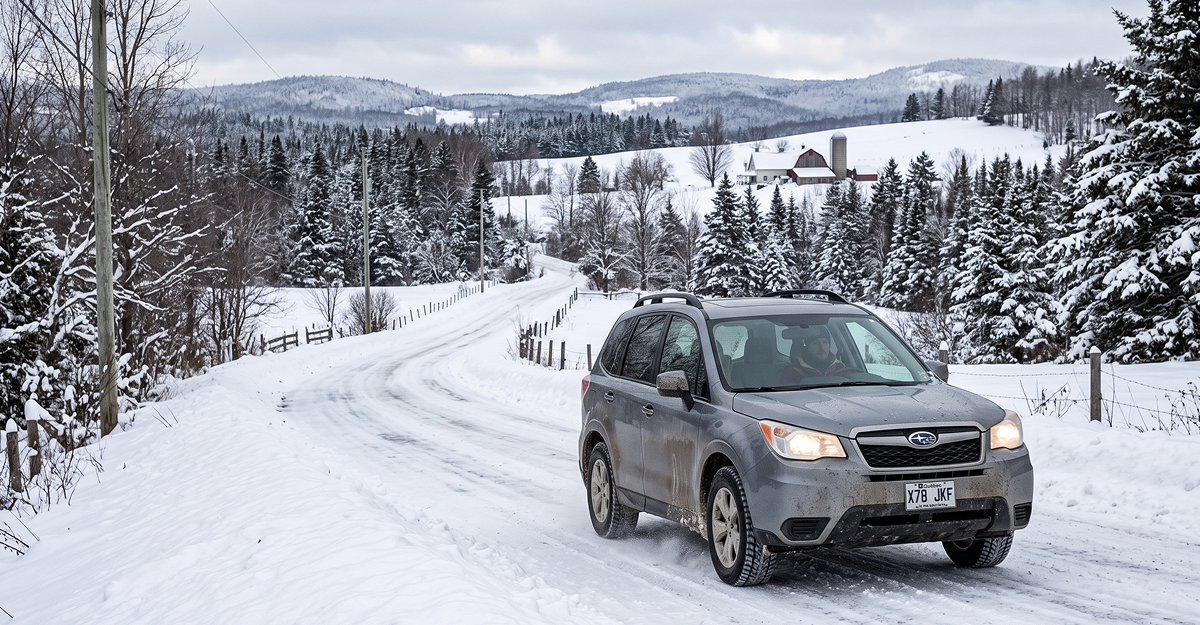
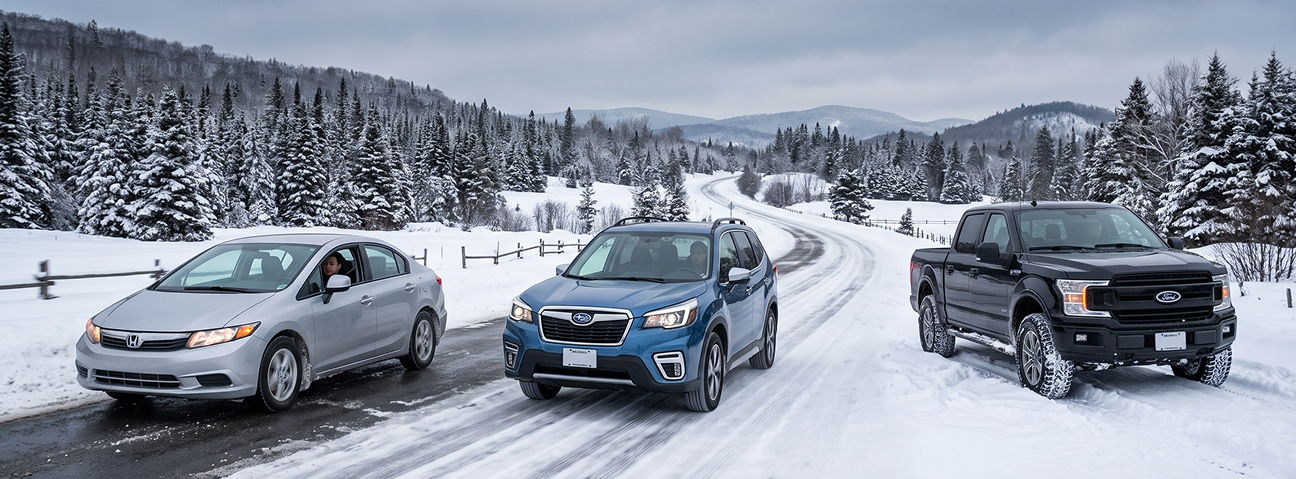
Used all-wheel-drive SUV on a snowy road in Quebec

FWD, RWD, AWD, 4×4: What Are We Talking About?

Four major drivetrain families share the used-vehicle market, and they do not work the same way at all:

  • Front-wheel drive (FWD): the engine drives the front wheels. This is the configuration of the vast majority of cars and of several entry-level compact SUVs. The engine’s weight sits over the wheels that pull, a natural advantage in snow.
  • Rear-wheel drive (RWD): the engine drives the rear wheels. You will find it on sports cars, certain luxury sedans and several base pickup trucks. It is the trickiest configuration in winter without ballast or good tires.
  • All-wheel drive (AWD): the vehicle automatically splits power between all four wheels, with no input from the driver. This is the system found on modern SUVs and “all-season” cars.
  • True 4×4: a robust system with a transfer case, designed for off-roading and trucks. A transfer case is a mechanism that lets you lock the power split between front and rear, and often engage a low range (very short gears that multiply the engine’s force at low speed).

Where All-Wheel Drive Shines

Let’s be fair: all-wheel drive is remarkably effective in its own domain, traction. Four wheels pushing instead of two means a confident start at the green light on a snow-covered road, an icy hill climbed without wheelspin, and a way out of your parking spot even when the plow has left a small snowbank behind your vehicle.

On a country road that gets plowed late, or in a sloped driveway, that extra traction translates into real confidence behind the wheel. It is precisely why all-wheel drive has taken over nearly every SUV sold in Quebec.

What All-Wheel Drive Will Never Do for You

Here is the point that advertising systematically leaves out: all-wheel drive does not improve braking. Every vehicle, whatever its drivetrain, already brakes with all four wheels. As Quebec’s automotive columnists keep reminding us, an all-wheel-drive vehicle does not stop any faster than an equivalent front-wheel-drive one; stopping distance depends on tire grip, not on the number of driven wheels.

The same goes for cornering: if your speed is too high for the available grip, the vehicle slides, all-wheel drive or not. The well-documented danger is a false sense of security: because the vehicle accelerates confidently on snow, you drive faster than you should, and you end up with the same braking distance as everyone else, but more momentum.

Four driven wheels help you get going. They do not help you stop.

The Real Winter Champions: Your Tires

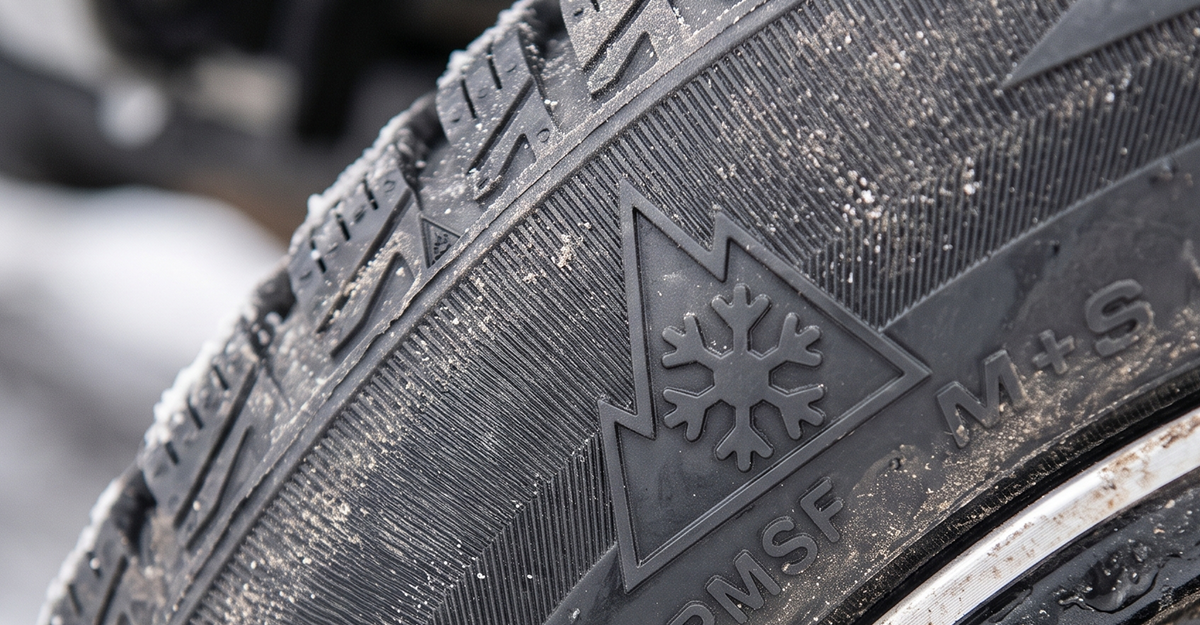
In Quebec, the law requires winter tires from December 1 to March 15 inclusively, under penalty of a fine of $200 to $300. To be compliant, tires must carry the mountain-snowflake pictogram, a symbol showing a three-peak mountain containing a snowflake, moulded directly into the tire’s sidewall.

Why is the law so strict? Because the difference is measurable. As soon as the temperature drops below 7°C, the rubber in all-season tires hardens and loses its grip, while winter tire rubber stays supple. The result: on cold or snow-covered pavement, studies from the Canadian tire industry and Quebec’s ministry of transport measure braking distances 25 to 30% shorter with winter tires than with all-seasons.

In other words, a front-wheel-drive car on good winter tires will stop faster than an all-wheel-drive vehicle rolling on worn or ill-suited tires. If your budget forces you to choose, choose the tires. We have also written a complete guide to winter tire dates, obligations and tips in Quebec, and our tire centre can set you up on site.

Mountain and snowflake pictogram on the sidewall of a winter tire

What Does All-Wheel Drive Cost, at Purchase and at the Pump?

All-wheel drive is not free, and its cost hides in three places. First at purchase: on a new vehicle, the option generally runs between $2,000 and $3,000, a gap that largely carries over to the used market, where the all-wheel-drive version of a given model sells for more than the front-wheel-drive version. The good news: part of that value is recovered at resale time.

Then at the pump: the additional components add weight and mechanical friction, which translates into a few extra tenths of a litre per 100 km compared with the same vehicle in two-wheel drive. Over five years of driving, the added fuel bill runs into the hundreds of dollars.

Finally, at maintenance time: an extra differential, driveshafts, clutches or a transfer case are all parts that need their oil changes and that can, with age, require repairs. A little-known detail: on several all-wheel-drive systems, all four tires must be replaced at the same time to avoid damaging the mechanism, even if only one is worn out.

Front-Wheel Drive and Good Tires: The Underrated Duo

For the majority of Quebec drivers who travel in the city or the suburbs, on roads cleared within hours of a storm, a well-shod front-wheel-drive vehicle does the job very well. The engine’s weight presses down on the driven wheels, and the electronic aids that come standard on recent vehicles (traction control, which limits wheelspin under acceleration, and electronic stability control, which brakes individual wheels to keep the vehicle on its intended path) make up for much of all-wheel drive’s historical advantage.

The savings at purchase, at the pump and in maintenance can then be reinvested intelligently: four top-quality winter tires, a rustproofing treatment, or simply a lighter weekly payment.

Who Really Benefits From All-Wheel Drive?

All-wheel drive is fully justified in certain very specific situations:

  • You live on a country road or a secondary road that gets plowed late, where traction makes the difference between getting going and going nowhere.
  • Your commute includes steep hills, as in the Laurentians or Lanaudière, often icy before the abrasives trucks come through.
  • You leave early in the morning, before the plows, or your schedule does not let you wait for snow clearing.
  • You tow a trailer or snowmobiles during the cold season.
  • You drive a lot of winter kilometres on regional roads with changing conditions.

If you recognize yourself in two or three of these situations, the investment is easy to defend. Otherwise, ask yourself honestly: how many days per winter would front-wheel drive really have held you back?

Our Auto Durocher advice: whatever the drivetrain, set aside part of your budget for four quality winter tires first; that is the equipment that actually shortens your braking distances. Then compare the front-wheel-drive and all-wheel-drive versions of the model you are interested in: if you drive mostly in the city on cleared roads, a well-shod front-wheel-drive vehicle will do the job, and the price difference will pay for your tires.

And True 4×4, Who Is It For?

The transfer-case 4×4 found on pickup trucks and off-road SUVs plays in another league: work sites, forest roads, boat ramps, heavy towing, a cottage reached by an unplowed road. Its low range and lockable modes offer a capability that all-wheel drive cannot match.

In return, it is heavier, thirstier and brings nothing more than all-wheel drive in everyday traffic. If your winter is spent on the boulevard rather than in the forest, you are paying for a capability you will never use.

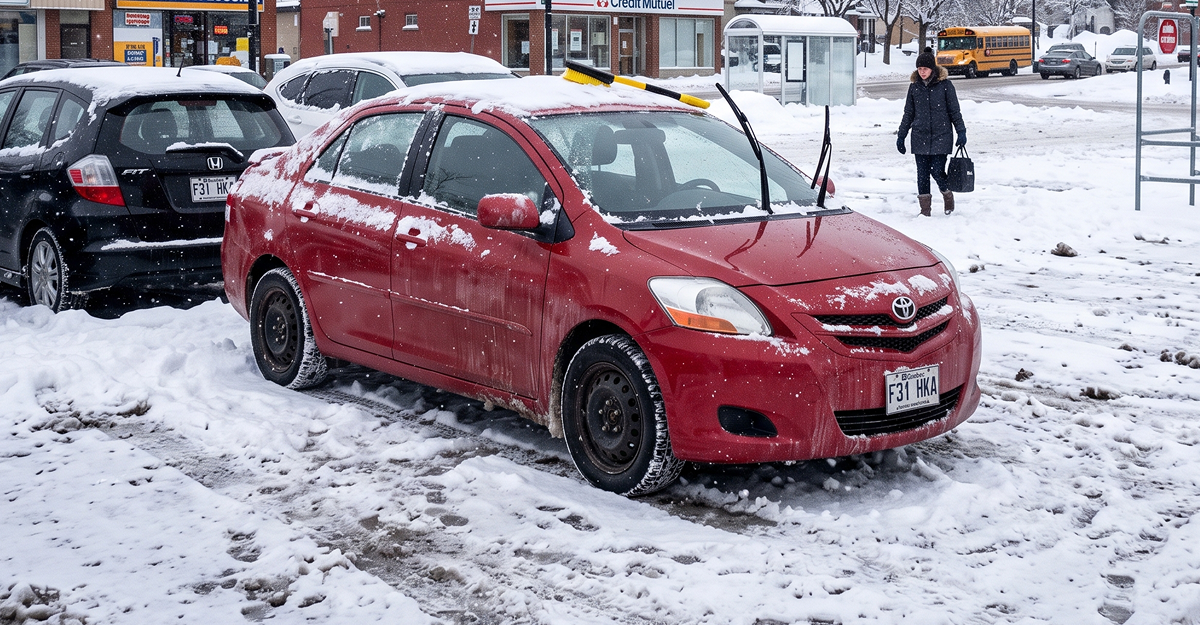
Front-wheel-drive car fitted with winter tires in a snowy parking lot

Checking the Drivetrain on a Used Vehicle Before You Buy

On a used all-wheel-drive vehicle, a few simple checks are essential before signing:

  • On the test drive, listen for dull noises or vibrations in tight, low-speed turns, a classic symptom of a tired differential or all-wheel-drive clutch.
  • Ask for the system’s maintenance history: differential and transfer case oil changes should appear in it.
  • Examine the tires: four identical tires with even wear are the sign of a careful owner; mismatched tires may have put a strain on the system.
  • Check for the mountain-snowflake pictogram if winter tires are included in the transaction.

At Auto Durocher, we inspect and test every vehicle before putting it up for sale, drivetrain included, and we show you the vehicle’s history with complete transparency.

What to Remember Before Choosing Your Drivetrain

  • All-wheel drive improves traction (starts, hills, deep snow), but shortens neither braking distances nor cornering grip.
  • Winter tires, mandatory from December 1 to March 15, reduce braking distances by 25 to 30% on cold pavement: they are the number one safety factor.
  • All-wheel drive costs more at purchase (often $2,000 to $3,000 on a new vehicle, a gap carried over to the used market), at the pump and in maintenance.
  • A recent front-wheel-drive vehicle with good winter tires is enough for most urban drivers; all-wheel drive earns its keep in the regions, on hills and outside snow-clearing hours.
  • True 4×4 is a work and off-road tool, not a piece of winter safety equipment.

Shop for Your Winter With Confidence

An economical front-wheel-drive car, an all-wheel-drive SUV or a 4×4 truck: the right choice depends on your commute, your region and your budget, not on advertising. At Auto Durocher, we take the time to analyze your real needs before recommending a vehicle, and our inventory of inspected used vehicles covers all three drivetrain families, in every price range.

And if budget is on your mind, our financing options, offered through 18 financial institutions on vehicles sold at our dealership, adapt to your situation, second-chance credit included. All-wheel drive is a plus. Four good winter tires are the foundation.

Sources

The D-Days have arrived!

Enjoy exclusive discounts from November 14th to 30th

Price reduction on ALL vehicles.
Vin-lock offered free of charge to each customer.

Preferential interest rate throughout the promotion.

$500 Visa card with the purchase of mechanical protection.

Easter Holiday
Schedule

Sales Mechanical service / parts
Friday, April 3 Regular schedule (9 AM – 8 PM) Regular schedule (Closed at noon)
Saturday, April 4 Regular schedule (9 AM – 3 PM) Closed
Sunday, April 5 Closed Closed
Monday, April 6 Regular schedule (9 AM – 8 PM) Closed

Evaluate your credit for free

Get your credit score for your next vehicle purchase! No impact on your score!

The D-Days have arrived!

Enjoy exclusive discounts from November 14th to 30th

Price reduction on ALL vehicles.
Vin-lock offered free of charge to each customer.

Preferential interest rate throughout the promotion.

$500 Visa card with the purchase of mechanical protection.

Disclaimer – Payment Estimator Tool

Payment Calculator

This payment estimation tool is for informational purposes only and does not constitute a credit offer within the meaning of the Consumer Protection Act (CQLR c. P-40.1). The amounts displayed are estimates only and may differ from the actual terms that will apply to the credit contract.

The selling price, credit rate, and actual payments will be determined at the time a written contract is concluded in accordance with applicable legal requirements.

Any financing offer is subject to credit approval by a third-party financial institution, in accordance with applicable lending criteria. The consumer may not qualify for the estimated credit rate displayed.

Base Price

The displayed price is based on the base price established by Auto Durocher. It excludes, among other things:

  • applicable sales taxes (GST and QST),
  • specific duties, including the air conditioning tax and environmental levies (if applicable),
  • transportation and preparation fees (if applicable),
  • options, equipment, and accessories,
  • dealer administration fees,
  • security registration fees (RDPRM) in the case of financing,
  • and any other fees payable under the contract.
    In accordance with the Consumer Protection Act, the total price to be paid will be clearly indicated in the sales or credit contract.


While we make every effort to ensure the accuracy of the information, errors may occur. Consumers are encouraged to contact Auto Durocher directly for complete and up-to-date information.

Credit Rate

The credit rates displayed are provided for information purposes only. The actual annual percentage rate (APR) will be disclosed in accordance with the Consumer Protection Act in the credit contract.
The applicable rate will depend, among other factors, on:

  • the consumer’s credit profile,
  • the terms of the financing,
  • and the selected financial institution.


Not all consumers will qualify for the lowest available rates. Certain conditions, restrictions, and eligibility requirements apply.

Estimated Payment – Financing

The estimated payment represents an approximation of periodic payments (principal and cost of credit) for an instalment credit contract relating to a used vehicle.
The actual payments will be set out in a written contract specifying, in particular:

  • the amount of credit,
  • the annual percentage rate (APR),
  • the cost of credit,
  • the number and amount of instalments,


in accordance with applicable provisions of the Consumer Protection Act.

The displayed amounts do not include certain fees, including administration fees, security registration fees, and other fees permitted by law.

Weekly payments are calculated based on the equivalent monthly payments using an annualization method, divided over fifty-two (52) weeks. This method is provided for estimation purposes only and may differ from the method used in the final contract.

Consumers are encouraged to consult Auto Durocher to obtain full disclosure in compliance with legal requirements before entering into any agreement.

Auto Durocher Weekends

Are Back!

Buy your vehicle and get a chance

To win $5000

in travel credit

From Friday to Monday only

Draw on September 1, 2026
Contest rules are available on our website or
at the Auto Durocher reception desk.