The price on the windshield of a used vehicle often tells only a fraction of the story. In Quebec, where the climate, provincial taxation and the cost of energy each follow their own trajectory, two vehicles sold at the same price can, after five years of ownership, produce a gap of several thousand dollars.
That is precisely what total cost of ownership (TCO) measures: the actual amount spent to acquire, fuel, maintain, insure and register a vehicle over the entire ownership period, net of its resale value.
In 2026, the question “electric, hybrid or gas?” takes on new urgency. The stabilization of gas prices around $1.70 a litre, one of the lowest electricity rates in North America, the scheduled wind-down of the Roulez vert program and the arrival of an annual fee on electric vehicles in 2027 are redefining the economic equation.
For the used-vehicle buyer, these variables matter all the more because the steepest depreciation — that of the first years — has already been absorbed by the original owner.
This guide breaks down the total cost of ownership item by item, using 2026 Quebec data, to determine which powertrain truly offers the best value over five years. At Auto Durocher, a varied inventory of gas, hybrid and electric vehicles lets you compare these options side by side according to your budget and annual mileage.
The most common buyer mistake is to focus the negotiation on the purchase price, treating fuel, maintenance and insurance as diffuse, secondary expenses. Yet over a horizon of five years and 100,000 kilometres, these operating items often represent a sum equal to — or greater than — depreciation itself.
Total cost of ownership is made up of five major items. Depreciation — the difference between the price paid and the resale value — almost always remains the heaviest expense. Next come energy (gas or electricity), maintenance (mechanical work, tires, brakes), insurance and, finally, regulatory fees (registration, taxes and provincial contributions). It is the weighted sum of these five items, and not the sticker price alone, that reveals a vehicle’s true cost.
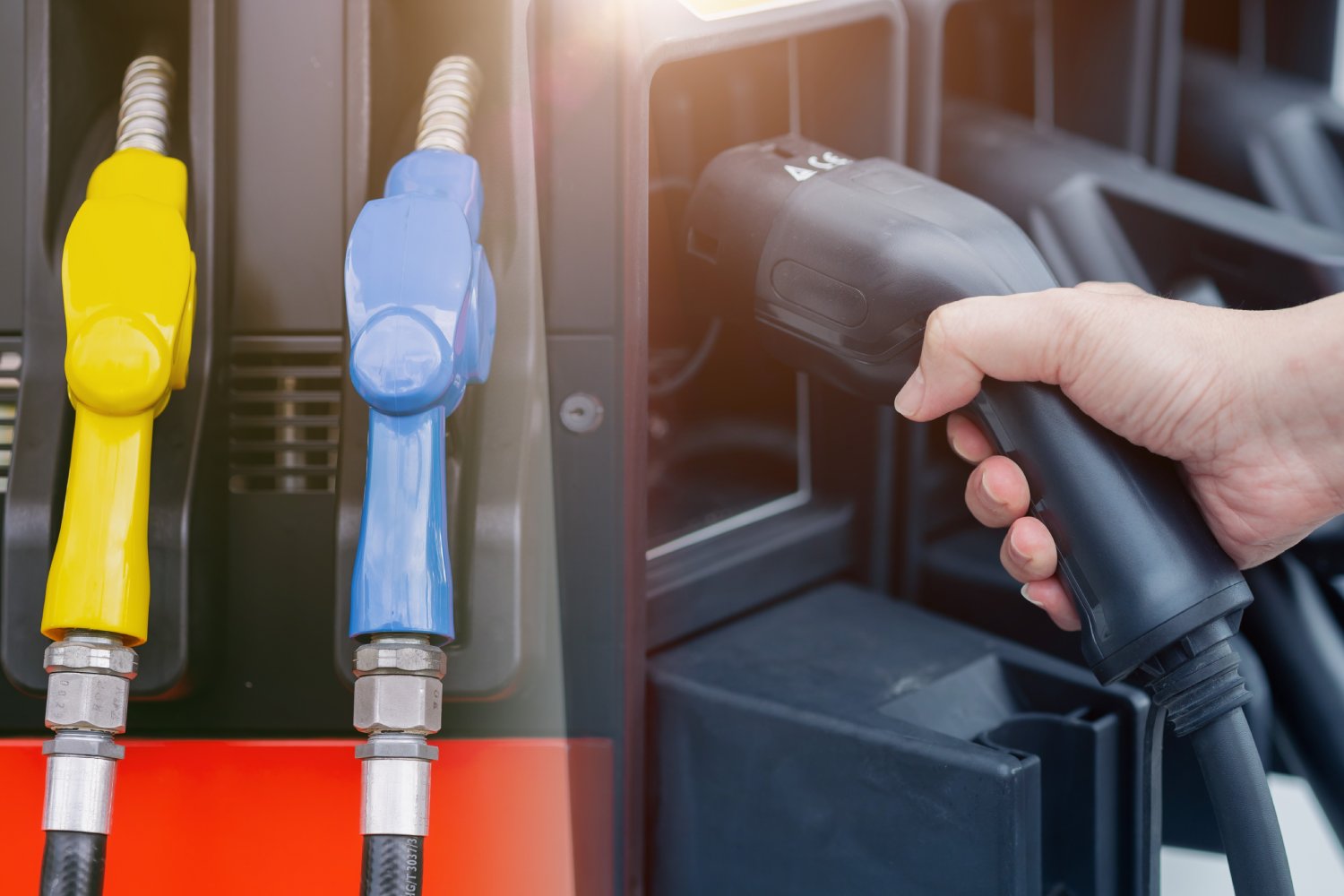
The powertrain influences each of these items in opposite directions. An electric vehicle radically reduces energy and maintenance, but generally costs more to insure and depreciates faster when new. A hybrid sits in an intermediate position and retains its value remarkably well. A gas vehicle remains the cheapest to buy and to insure, but its fuel bill weighs more heavily on the budget month after month. Understanding these trade-offs is the key to a rational decision.
No comparison of powertrains makes sense without anchoring it in real costs. Four parameters specific to Quebec in 2026 weigh on the calculation.
Residential electricity in Quebec remains a major competitive advantage for electric vehicles. On Rate D, the first-tier price stands at 6.76 ¢/kWh in 2026, after the 3% increase that took effect on April 1, and rises to 10.52 ¢/kWh beyond 40 kWh per day. For the vast majority of households that charge at home on a level-2 station, the energy consumed by the vehicle is therefore billed at the first-tier rate.
Concretely, charging an electric vehicle to travel 20,000 kilometres a year costs about $270 of electricity at home — an amount so low that it transforms the entire equation. Even when factoring in a few (more expensive) public fast-charging sessions and the winter range penalty, the realistic annual cost remains below $400.
On the combustion side, the average price of regular gas in Quebec hovers around $1.70 a litre in 2026, with regional gaps that can exceed 15 ¢ from one area to another. For a vehicle consuming 8 litres per 100 kilometres in real-world conditions (winter included), the annual fuel bill reaches nearly $2,720 — ten times the charging cost of an equivalent electric vehicle.
The annual registration fee for a passenger automobile is about $154 in 2026 outside the metropolitan area (the bill rises significantly in Greater Montreal because of the public-transit tax). Until now, electric vehicles benefited from reductions; that advantage is ending.
As of January 1, 2027, Quebec will impose an annual contribution of $125 on electric-vehicle owners and $62.50 on plug-in hybrid owners (conventional, non-plug-in hybrids are not subject to it), to offset the share of the fuel tax they do not pay. This contribution will be indexed annually. Over a five-year ownership period beginning in 2026, an electric vehicle will therefore absorb this charge for four of those five years — a factor to include in the calculation, even though it remains modest against the energy savings.
The provincial Roulez vert program, a pillar of Quebec’s electromobility, is entering its final phase. The purchase incentive for a used electric vehicle, once set at $2,000, has been reduced and will disappear entirely in 2027. For 2026, the buyer of an eligible used electric vehicle can still subtract roughly $1,000 from the acquisition cost — a boost worth confirming, as the amounts and criteria change quickly. The program’s end reinforces the urgency of acting before the end of 2026.
To compare apples with apples, we model the purchase of three recent used vehicles in the compact segment, kept for five years and driven 20,000 km a year, for a total of 100,000 km. The vehicles chosen are representative of the Quebec used-vehicle inventory: a gas sedan (such as a Honda Civic or Toyota Corolla), a conventional hybrid (such as a Toyota Corolla Hybrid) and an electric vehicle of comparable class (such as a Tesla Model 3 or Hyundai Kona Electric). Importantly for what follows: the electric vehicle is here the most expensive to buy — which reflects market reality for an EV of equivalent class and equipment — and it is precisely this starting disadvantage that its low operating costs will have to offset.
| Assumption | Gas | Hybrid | Electric |
| Purchase price (used) | $24,000 | $26,000 | $28,000 |
| Real-world consumption | 8.0 L/100 km | 5.2 L/100 km | 20 kWh/100 km |
| Energy cost | $1.70/L | $1.70/L | ~$0.095/kWh (blended) |
| Annual mileage | 20,000 km | 20,000 km | 20,000 km |
| Ownership period | 5 years | 5 years | 5 years |
The figures are provided as examples only, based on recent used models. Your actual situation will depend on the exact model, your driver profile, your region, and changes in energy prices and government programs.
This is the item where the gap widens most clearly. Moving a vehicle on electricity in Quebec costs a fraction of what gas requires.
| Powertrain | Annual energy cost | Cost over 5 years |
| Gas (8.0 L/100 km) | $2,720 | $13,600 |
| Hybrid (5.2 L/100 km) | $1,768 | $8,840 |
| Electric (20 kWh/100 km) | ~$380 | ~$1,900 |
Over five years, the electric vehicle saves nearly $11,700 in fuel compared with gas, and the hybrid saves about $4,760. A nuance is in order, however: winter performance reduces real electric range, and the use of public fast chargers (more expensive than home charging) erodes part of this advantage. The owner who charges mainly at home on a level-2 station captures almost all of the savings; the one who depends on public chargers recovers less.
The second advantage of electrified powertrains lies in the mechanics. According to CAA-Québec, electric-vehicle owners spend 40 to 50% less on maintenance than those who drive a gas vehicle: no oil changes, no oil filter, no spark plugs, no exhaust system, and greatly reduced brake wear thanks to regenerative braking.
| Powertrain | Estimated annual maintenance | Cost over 5 years |
| Gas | ~$900 | $4,500 |
| Hybrid | ~$750 | $3,750 |
| Electric | ~$350 | $1,750 |
The hybrid sits between the two: it keeps a combustion engine to maintain, but puts less strain on its brakes. One caveat specific to the electric vehicle is worth noting: such effective regenerative braking can lead to underuse of the mechanical brakes, whose discs end up rusting from lack of use. Inexpensive preventive maintenance, but not to be neglected in our climate, should be factored in.
Insurance is an item where the electric vehicle is at a disadvantage. Its premium is generally higher than that of a gas equivalent, mainly because of higher repair costs (battery, electronics, specialized bodywork) and a still-limited volume of policies. The gap is by no means automatic, however: some Quebec insurers offer discounts specific to electric vehicles, and the premium varies enormously by region, driving record and model.
For the purposes of our model, we use illustrative annual premiums of $1,300 for gas, $1,350 for hybrid and $1,550 for electric, or $6,500, $6,750 and $7,750 respectively over five years. The electric vehicle’s insurance surcharge (about $1,250 over the period) remains modest compared with its energy and maintenance savings, but it must appear on the balance sheet to avoid overly optimistic conclusions.
Depreciation is almost always the heaviest item in the total cost of ownership, and it is precisely here that buying a used vehicle reshuffles the deck.
When new, the powertrains diverge radically. Canadian industry data put average five-year depreciation around 41.8%, but with a considerable gap between electric vehicles (about 57%) and hybrids (about 35%), the latter retaining their value best of all. A new electric vehicle thus loses nearly 30% of its value in the first year alone.
For the used-vehicle buyer, this reality becomes a strategic advantage. By acquiring an electric vehicle a few years old, you let the first owner absorb the drop in value. Residual depreciation, over the following five years, flattens out and approaches that of the other powertrains.
| Powertrain | Purchase price | Estimated residual value (5 years) | Depreciation |
| Gas | $24,000 | $11,000 | $13,000 |
| Hybrid | $26,000 | $13,500 | $12,500 |
| Electric | $28,000 | $11,000 | $17,000 |
The hybrid stands out with the best value retention, making it the safest choice for anyone planning to resell. The electric vehicle, for its part, combines the highest purchase price and the heaviest depreciation in dollars — its Achilles’ heel. This starting gap of about $4,000 versus the hybrid, plus $4,500 on depreciation, must be entirely offset by energy and maintenance savings for the EV to remain advantageous. The long-term battery warranty, still active on a vehicle a few years old, also limits the risk of a nasty surprise on the vehicle’s most expensive component.
Adding up the five items — and subtracting the Roulez vert incentive for the used electric vehicle — the complete picture emerges.
| Item (5 years) | Gas | Hybrid | Electric |
| Energy | $13,600 | $8,840 | $1,900 |
| Maintenance | $4,500 | $3,750 | $1,750 |
| Insurance | $6,500 | $6,750 | $7,750 |
| Registration and taxes | $770 | $770 | $1,270 |
| Depreciation | $13,000 | $12,500 | $17,000 |
| Roulez vert incentive (used) | — | — | −$1,000 |
| Total cost of ownership | $38,370 | $32,610 | $28,670 |
| Cost per kilometre | $0.384 | $0.326 | $0.287 |
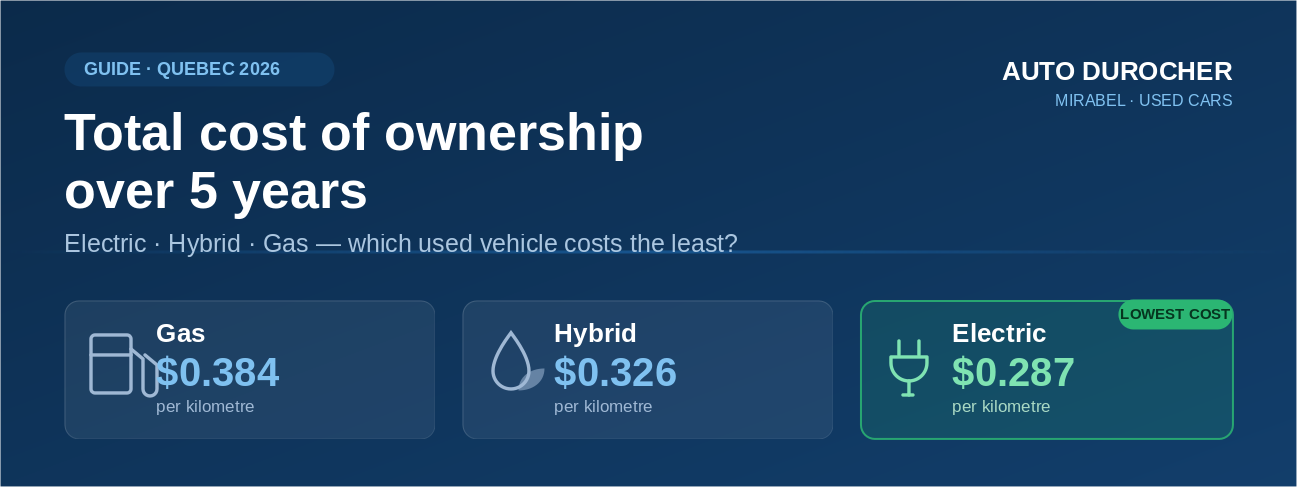
The verdict remains clear on financial grounds, all the more so because it holds up under the scenario least favourable to the electric vehicle: even when assigned the highest purchase price ($28,000) and the heaviest depreciation in dollars, the used EV still comes out about $9,700 cheaper than the gas equivalent over five years and 100,000 kilometres, while the hybrid saves nearly $5,800. The electric vehicle’s advantage does not come from its purchase price — where it starts out losing — but from energy and maintenance, two items where Quebec, thanks to its cheap hydroelectricity, opens a gap that neither the insurance surcharge, nor the 2027 provincial contribution, nor faster depreciation can close.
This result does not mean the electric vehicle is the right choice for everyone. The calculation assumes access to home charging, an annual mileage of 20,000 km and a tolerance for winter range constraints. Change these assumptions, and the balance shifts.
The “high-mileage driver with a home charger” profile. If you drive 20,000 km or more a year and have a level-2 station at home, the used electric vehicle is unbeatable. The more you drive, the more the energy-cost gap works in your favour, and the faster you recoup the insurance surcharge.
The “balance and peace of mind” profile. If you don’t have access to home charging, if you make frequent long trips, or if resale concerns you, the conventional hybrid offers the best compromise: a fuel bill cut in half compared with gas, no range anxiety, no additional provincial contribution and the best resale value on the market.
The “small budget and low mileage” profile. If you drive little (less than 12,000 km a year) and are looking for the lowest purchase price, a reliable, fuel-efficient gas vehicle can still make sense: its fuel disadvantage weighs less at low mileage, and its entry price remains the most accessible.
Total cost of ownership is the most honest tool for comparing used vehicles, but it requires weighing many variables: your mileage, your access to charging, your insurance profile and your resale plans. This is exactly the kind of analysis our team performs every day.
At Auto Durocher, in Mirabel, you will find gas, hybrid and electric vehicles under one roof, all rigorously inspected in our own shop. Our advisors can help you model your real total cost of ownership and, on the financing side, structure a loan that accounts not only for the monthly payment but for the overall operating cost. Come see us or browse our online inventory to compare the options that match your budget and your driving reality.
Sources :