








Rustproofing: Grease, oil, or electronics? The verdict on protecting your investment against Quebec salt

Rustproofing: Grease, oil, or electronics? The verdict on protecting your investment against Quebec salt

In Quebec, winter is unforgiving. Between road salt, calcium treatments, and constant humidity, our roads are a true all-you-can-eat buffet for corrosion. If you’ve just purchased a used vehicle, the question isn’t whether you should protect it, but how to do it effectively.

In this guide, we compare the three main methods to help determine which offers the best protection for your investment.

Why is rustproofing crucial for a used car?

Unlike a new vehicle that leaves the factory with minimal protection, a used vehicle has already faced the elements. Micro-cracks in the original sealant or rock chips under the chassis are all entry points for rust. Protecting a used vehicle is the key to extending its life by 5 to 10 years and maintaining its resale value.

1. Oil rustproofing (The classic annual treatment)

This is the most common and affordable method. Oil is sprayed under the chassis and inside body panels (doors, fenders, and hood).

  • How it works: Oil is hydrophobic; it repels water and seeps through capillary action into the smallest folds of the metal.
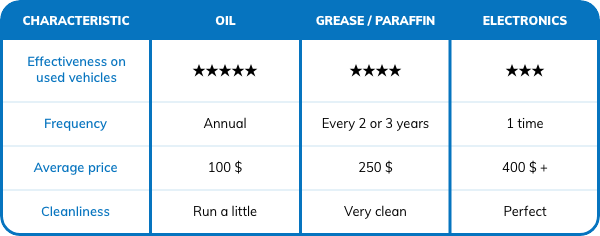
  • Advantages: Excellent penetration, helps neutralize existing rust, and is economical ($80–$130).
  • Disadvantages: It tends to drip (watch your paving stones!) and must be redone every year since it gradually washes away with road splashes.

2. Grease or paraffin rustproofing (The durable barrier)

Thicker than oil, grease (often paraffin-based) forms a waxy protective layer that hardens on the metal.

  • How it works: It is usually applied hot. As it cools, it creates a watertight and long-lasting barrier.
  • Advantages: Doesn’t drip, resists high-pressure washing and abrasion much better (sand, gravel). It can last 2 to 3 years.
  • Disadvantages: More expensive ($150–$350) and may trap moisture if applied improperly on a surface that is already wet.

3. Electronic module (The technological solution)

Increasingly offered by new car dealerships, this small box sends a low-intensity electrical current through the vehicle’s metal structure.

  • How it works: The science is based on the sacrificial anode principle (used on boats). In theory, the current prevents the chemical oxidation reaction.
  • The verdict: Although clean and permanent, its effectiveness on a used vehicle depends on its condition. For it to work, the metal must be perfectly sound. If rust has already started, the module cannot stop it as effectively as a physical barrier such as oil. That is why our vehicles undergo rigorous inspections.

Comparison table: Which protection should you choose?

Rustproofing: Grease, oil, or electronics? The verdict on protecting your investment against Quebec salt - Auto Durocher

When should you rustproof your vehicle?

People often tend to wait for the first snowflakes in the fall to protect their car. However, spring and summer are much more strategic periods, provided one critical condition is met: cleaning.

  1. Neutralizing salt (in spring): A serious spring treatment starts with a high-pressure undercarriage wash. This is the ultimate step to remove salt accumulated during winter before rising temperatures help it “eat into” the metal.
  2. Heat works in your favor (in summer): Rustproofing products (especially oil-based ones) perform much better when it is warm. They penetrate deeper into the metal seams and welds than in the middle of November on a frozen chassis.
  3. Don’t trap the enemy: Applying a product in the fall or without deep cleaning often means trapping residues. By treating your vehicle as soon as the weather is nice, you start from a clean and dry foundation.

Professional tip: When choosing your rustproofing specialist, make sure they perform a proper undercarriage wash before application. Applying oil on salted dirt is like putting a bandage on a dirty wound — it hides the problem instead of solving it.

The verdict

For a used car in Quebec, oil rustproofing remains the undisputed champion. Its ability to penetrate where rust has already begun to settle makes it the safest and most cost-effective option for long-term investment protection.

Your used vehicle expert’s advice

When buying a used car, always ask whether rustproofing treatment has been done in the past. At Auto Durocher, we systematically inspect the chassis of our vehicles to ensure they are sound before sale. A vehicle that has already been treated is a clear sign that the previous owner took good care of it.

Would you like to know your vehicle’s value?

Come visit our dealership for an evaluation of your bodywork and mechanical components.

Our certified technicians are your reference for assessing your vehicle and determining its potential resale value.

Les Jours D sont arrivés !

Profitez de rabais exclusif du 14 au 30 novembre

Baisse de prix sur TOUS les véhicules.

Vin-lock offert gratuitement à chaque client.

Taux d’intérêt préférentiel durant toute la promotion.

Carte Visa de 500$ à l’achat d’une protection mécanique.

Easter Holiday
Schedule

Sales Mechanical service / parts
Friday, April 3 Regular schedule (9 AM – 8 PM) Regular schedule (Closed at noon)
Saturday, April 4 Regular schedule (9 AM – 3 PM) Closed
Sunday, April 5 Closed Closed
Monday, April 6 Regular schedule (9 AM – 8 PM) Closed

Evaluate your credit for free

Get your credit score for your next vehicle purchase! No impact on your score!

The D-Days have arrived!

Enjoy exclusive discounts from November 14th to 30th

Price reduction on ALL vehicles.
Vin-lock offered free of charge to each customer.

Preferential interest rate throughout the promotion.

$500 Visa card with the purchase of mechanical protection.

Auto Durocher Weekends

Are Back!

Buy your vehicle and get a chance

To win $5000

in travel credit

From Friday to Monday only

Draw on September 1, 2026
Contest rules are available on our website or
at the Auto Durocher reception desk.