







Draw on September 1, 2026
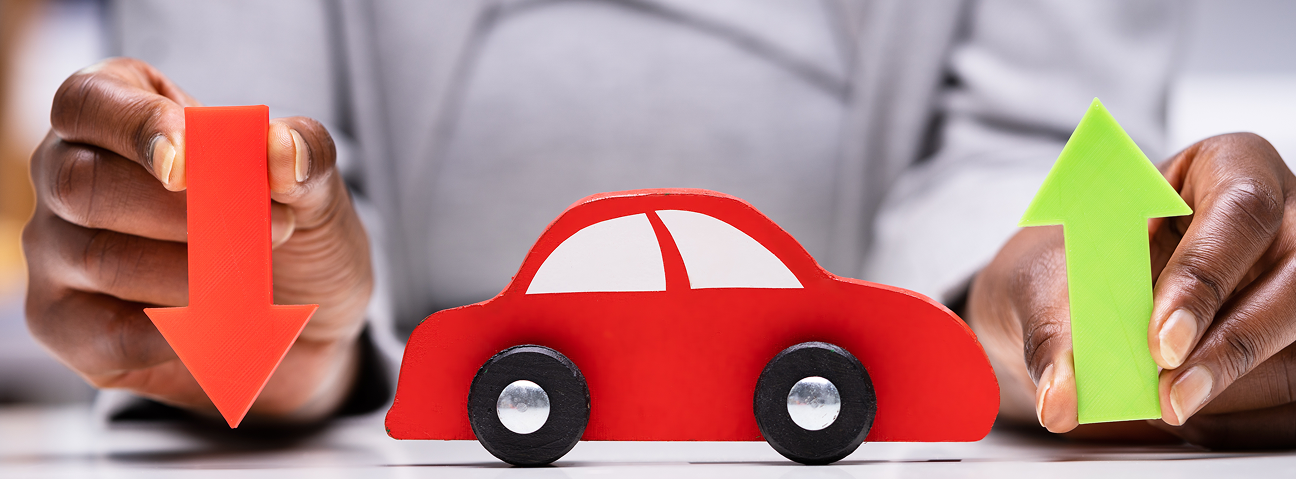
Your vehicle no longer meets your needs, but you still have two, three, sometimes four years of payments left. Can you still trade it in at a dealership? The short answer: yes, in many cases. The real question is under what conditions, and whether it is a good idea in your situation.
In this guide, we demystify trading in a financed vehicle in Quebec: the difference between your loan balance and your trade-in value, what negative equity is, the role of the creditor registered in the RDPRM, how a balance can (or cannot) be rolled into new financing, and the situations where you are better off waiting.
Before you even start shopping, get two numbers. The first is your loan balance: the exact amount you would have to pay your financial institution today to close the file. Ask your lender for a payout statement or an up-to-date balance; this figure includes the remaining principal and, sometimes, fees.
The second is your vehicle’s trade-in value: what a dealer is prepared to give you to take it back. It is generally lower than the price you would see in classified ads, because the merchant takes on the inspection, reconditioning and resale. We have already explained in detail how a dealer appraises your trade-in and how to make the most of it; here we look at the other side of the equation, the amount that remains to be paid.
Comparing these two numbers determines everything else. Trade-in value higher than the balance: you have positive equity, which will serve as a down payment. Balance higher than the trade-in value: you are in negative equity. That second scenario is the one worth a closer look.
Negative equity is the difference between what you still owe on your financing and your vehicle’s current market value. Owing $17,500 on a car worth $14,000 means being in negative equity by $3,500.
The phenomenon is far from marginal. The Financial Consumer Agency of Canada, the federal body that protects consumers of financial products, calculated that the proportion of Canadian consumers trading in a vehicle with negative equity rose from about 20% to 30% between 2010 and 2015, with rolled-over balances averaging around $7,000. At the end of 2024, industry data still put that proportion at around one traded-in vehicle in five. If this is your case, you are in very good company, and there are orderly ways out of it.
Two curves cross in the wrong place. On one side, depreciation: according to the Financial Consumer Agency of Canada and financial institutions, a new vehicle can lose 20% to 30% of its value in the first year alone. On the other, amortization: on an 84- or 96-month loan, the first payments mostly cover interest, and the principal comes down slowly. For several years, the debt therefore shrinks more slowly than the vehicle’s value.
And these long terms have become the norm. Quebec’s Office de la protection du consommateur, like CAA-Quebec, notes that car financing now commonly stretches over 5 to 8 years, precisely because it makes the weekly payment easier to swallow. The payment goes down, but the period during which you owe more than the car is worth gets longer. We devoted a full article to choosing between financing over 60, 72, 84 or 96 months if you want to dig into this aspect before your next purchase.
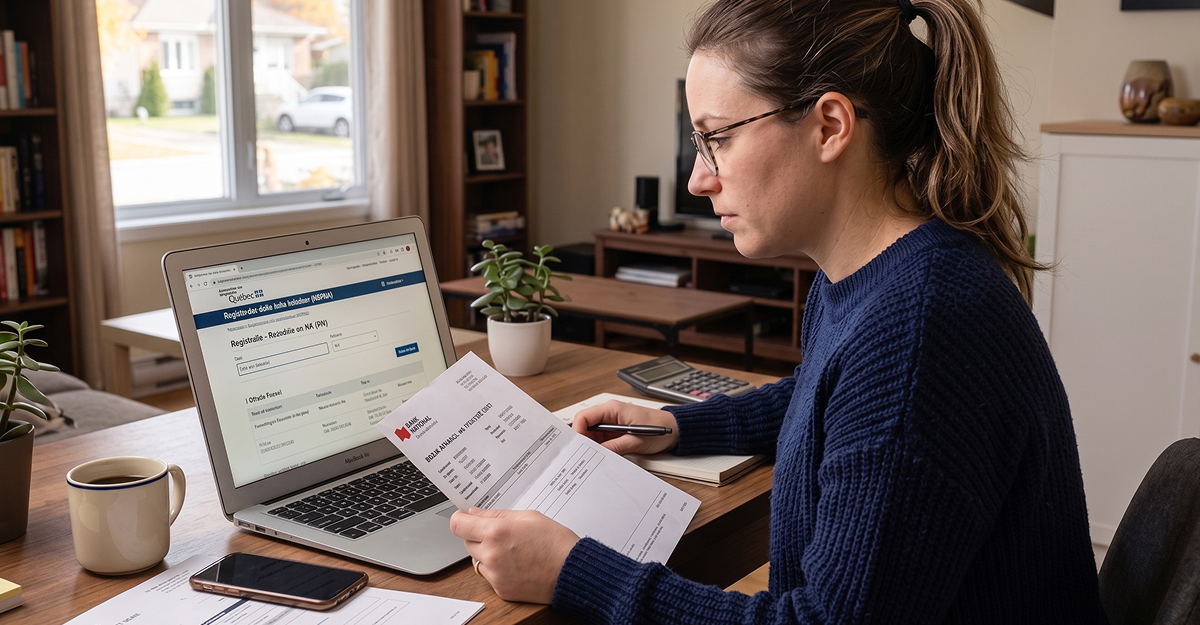
As long as your loan is not paid off, your financial institution holds security on the vehicle, and that security is registered in the RDPRM, the Registre des droits personnels et réels mobiliers (Quebec’s register of personal and movable real rights), a public registry that lets anyone check whether a piece of property, such as a car, carries a debt. In practical terms, as long as the registration remains, the vehicle cannot change hands as easily: the unpaid creditor could claim what is owed or even repossess the vehicle, no matter who has become its owner.
That is why no reputable merchant takes back a vehicle without settling the loan attached to it, and it is also why Éducaloi, Quebec’s legal information organization, recommends that every buyer check the registry before a transaction. The search is done online, by vehicle identification number, for $5. Once the loan is paid off, the creditor has the registration cancelled and the vehicle is once again free of debt.
Good news: you do not have to sell your vehicle yourself or pay off your loan before shopping. During a trade-in, the dealer obtains the exact balance from your creditor, pays off that loan directly as part of the transaction, then has the RDPRM registration cancelled. You do not have to advance any money to “free up” the vehicle.
If your trade-in value exceeds the balance, the difference is yours: it is applied as a down payment on the new vehicle. A small advantage specific to trading in with a merchant: under Revenu Québec’s rules, sales taxes are then calculated on the difference between the price of the vehicle you are buying and the value given for your trade-in, not on the full price. A trade-in value of $14,000 therefore cuts your tax bill by more than $2,000.
When equity is negative, the shortfall does not disappear by magic: it has to be paid. Three avenues exist. You can pay the difference in cash. You can wait until the loan drops below the vehicle’s value. Or, the most common option, the difference can be added to the new vehicle’s financing: this is rolling over the balance, sometimes called carrying the balance forward.
This practice is entirely legal and governed by the Consumer Protection Act, the Quebec law that regulates contracts between merchants and consumers and that requires the merchant, among other things, to clearly disclose the total cost of credit.
Two warnings are in order, however. First, a balance rollover is never automatic: it is the financial institution that decides, based on your credit file, your income and the amount requested, whether or not to approve financing that includes the old debt. Second, you will pay interest on that rolled-over debt for the entire term of the new loan. The rollover therefore has to be worth it.
Let’s take a fictional scenario. Émilie still owes $17,500 on her sedan, and the dealer gives her a trade-in value of $14,000. Her negative equity is therefore $3,500. She chooses a used SUV listed at $22,000.
The example shows where every dollar goes, and what the rollover really costs.
Trading in a vehicle that is still financed can be a perfectly rational choice in certain situations:
Conversely, some signals call for patience. If the negative equity is large and the only way to close the deal is to stretch the new loan to the maximum, you risk digging the hole deeper: every rollover increases the debt that will, one day, have to be absorbed. If your budget is already tight, a higher payment weakens everything else. And if your current vehicle is reliable and suited to your needs, the smartest math is often to simply keep paying it off.
Three moves speed up the return to balance: make extra payments on the principal when your contract allows it, as the Consumer Protection Act entitles you to repay a loan before it comes due; keep the vehicle a few more months, until the balance drops below the trade-in value; or shrink the gap with a cash amount at the time of the transaction.
Our Auto Durocher advice: before visiting a dealership, ask your lender for your exact payout balance and have your vehicle appraised. You will know, before falling in love with a model, whether you are in positive or negative equity and by how much. A successful transaction is decided with these two numbers in hand.
Many people carrying negative equity also carry an imperfect credit file: a consolidation, late payments, a consumer proposal. The two realities often go hand in hand, and there is no shame in that. A divorce, a job loss or an illness is enough to derail even the most orderly finances.

At Auto Durocher, we work with 18 partner financial institutions, which multiplies the chances that a lender will accept your file as it is, including, when approved, the rollover of an existing balance. Our 2nd chance credit financing team looks at your situation without judgment: you are not just a number, you are a person who deserves a second chance.
Bring your loan statement, have your vehicle appraised and ask all your questions: it is the simplest way to know where you stand. At Auto Durocher, we lay out every scenario for you in black and white, balance, trade-in value, rollover and payment, so the decision remains yours. Explore our financing options or come see us in Mirabel.
A lower payment is tempting. A vehicle that fits your needs is better.